Disclaimer: Since I’ve never written a blog before, I will be experimenting a bit with format/style/etc.
I’ve officially decided that the biggest difference between living in Nigeria and the US….is having to work on a Mac laptop. All joking aside, for the amount of time that I spend on a computer (8+ hours a day) not being able to use regular keyboard shortcuts started out as a huge pain. For example, why do macs have the command key?
But, at the end of the day I’ve begun to get used to it. Similarly, I’ve begun to acclimate to living here in Nigeria. Some things that I’ve had to adjust to since leaving the US:
- Limited brewed coffee – I’m back to the instant stuff. I ended up buying one of the “3-in-1” Nescafe packs that have sugar/cream/coffee powder mixed together, it’s a bit sweet but I used to drink this in college so I’m used to it. Brewed coffee is not really a thing here since it’s pretty expensive. People swear by Nescafe Gold though as the most drinkable instant stuff.
- The heat – while there is A/C (thank God) in both my apartment and the office, the temperature last week was high 80’s but felt like low 100’s with humidity. My first week here I felt like I was constantly sweating.
- Limited wi-fi/data usage – When I’m not in the office on wif-fi, I tether to a mi-fi device provided by Paystack which shows how much data I use. Seeing my usage across my phone and computer has been pretty sobering. I’ve been trying to cut back after realizing what a data junkie I’ve been (5GB in 3 days).
- Brushing my teeth using bottled water – to make sure I don’t get cholera
- I’ve started to get more used to this. I actually can’t drink any tapwater, but there are watercoolers at the apartment/office that I can refill my waterbottle from.1
- Uber safety – usually in Chicago I could jump in an Uber and trust that I was going to get to my destination. Whenever I’m in a car here, I’m always tracking my location to make sure I’m not going to get kidnapped or get driven the long way.
- Sidebar: if I was female, this probably wouldn’t make the list as a “difference” between Nigeria and the US. Major props to women, I don’t know how you all survive this because the constant paranoia alone would knock 20 years off my lifespan.
- Public transportation – Chicago’s El really can’t be beat, but of course I’m biased.
- I’ve begun walking to work (~15 minutes) and getting Keke rides the other 50% of the time. However to take a Keke I need to have small bills since a common scam is for people to tell you that they don’t have any change. I’ve started hoarding small bills to save up for when it starts to get hotter in February. Rides usually cost about 200 Naira (or ~$0.60) but require some bartering before you get in (see previous post).
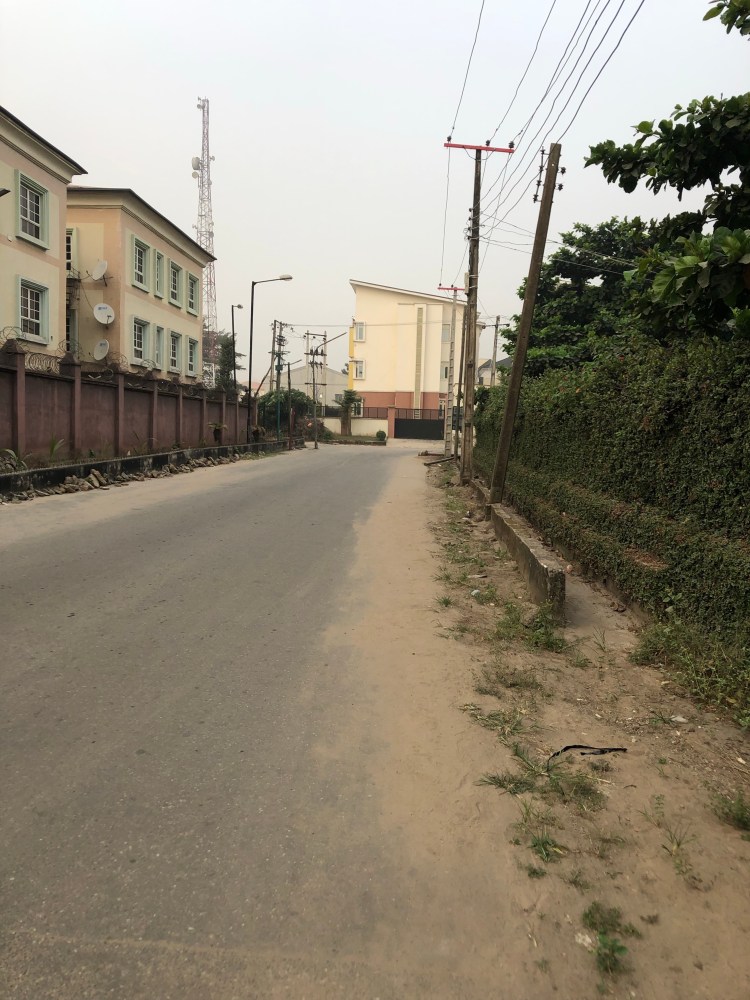
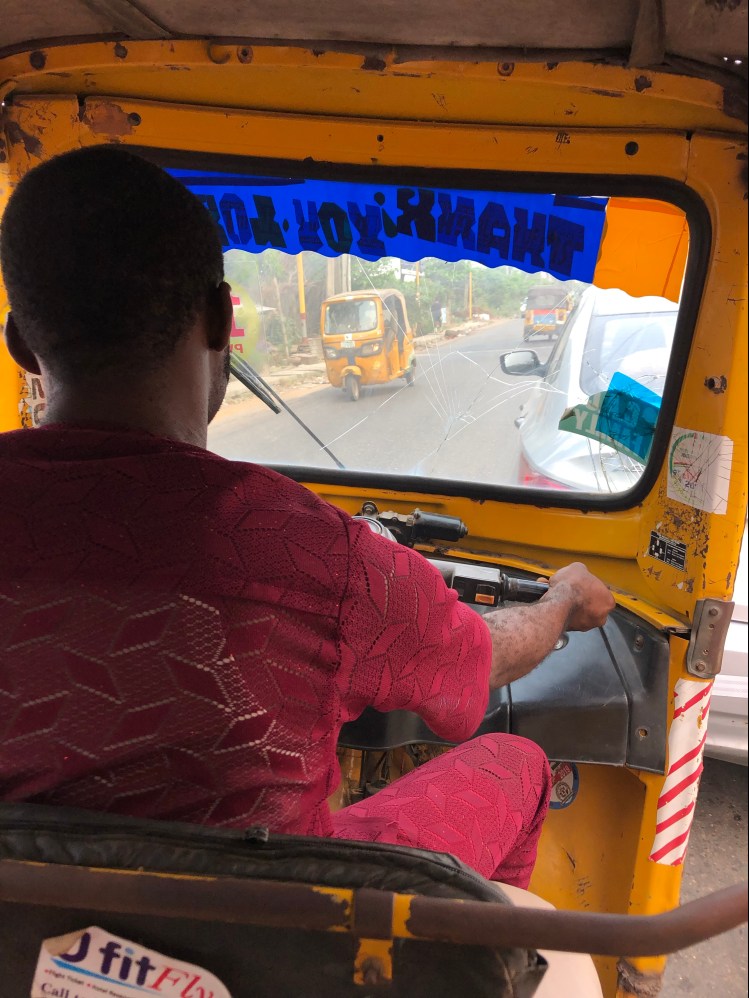
- Rules of the road – driving in Lagos looks and feels terrifying. There’s constantly a stream of cars/kekes/okatas everywhere. I was walking the other day and saw a truck barrel through an intersection 5 seconds after the light had turned red. My Uber drivers take 3-point turns in the middle of oncoming traffic and just ignore the honking.
- Unreliable electricity – this is a HUGE problem in Lagos which is solved in most cases by having a back-up electricity generator. While I was having a conversation with my apartment-mate Emmanuel, the lights went out and we continued our talk in the dark for ~2 minutes before it came back on.
- A coworker told me that for some startup businesses, the money to pay for electricity can be the most expensive cost
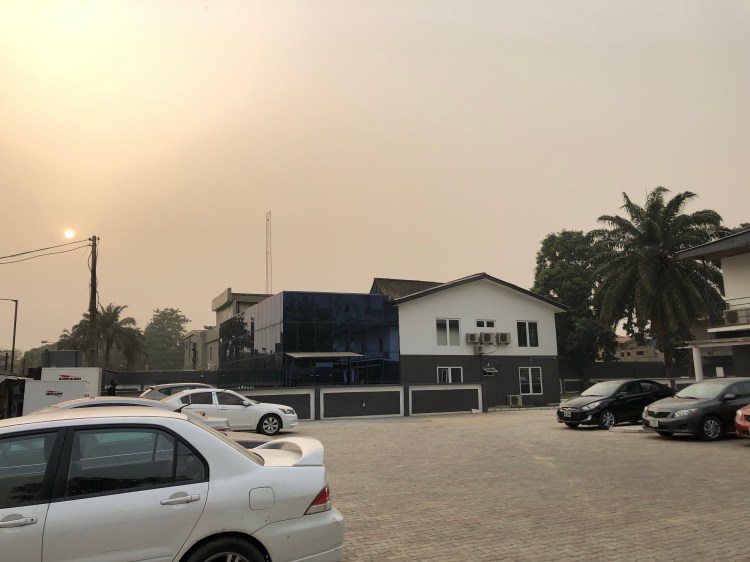
- Hazy skies – there’s a wet season and a dry/dust season where sand from the Sahara to the north gives the sky a blanket of haze. It also can apparently lead to extreme allergies. Almost all days are pretty hazy and the sky is generally a grayish-orange color.
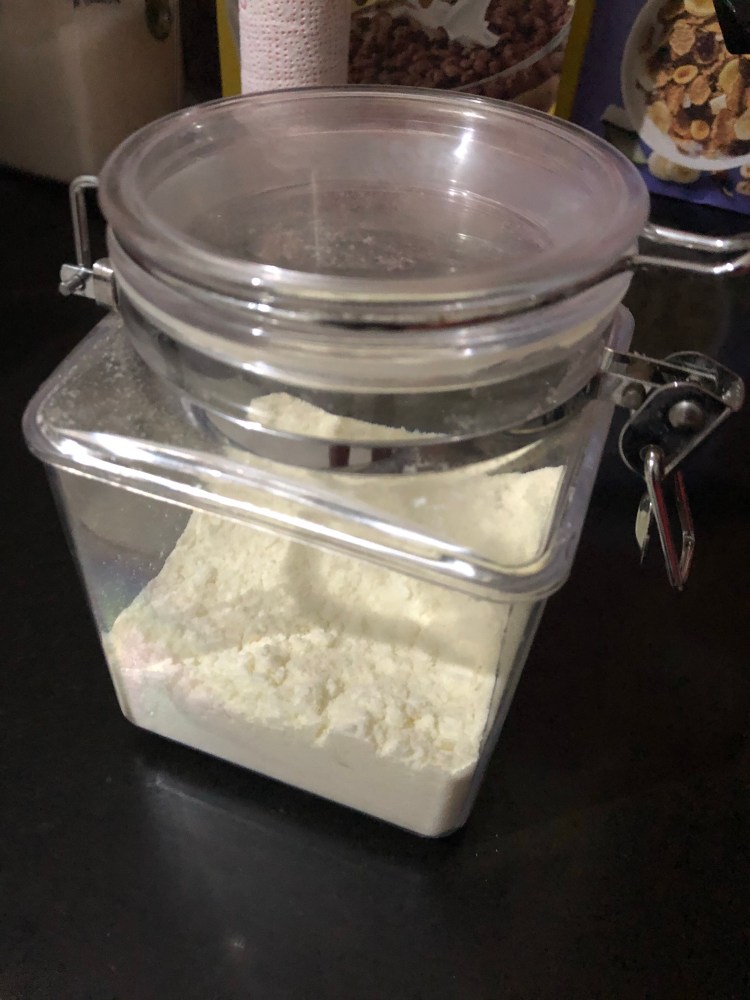
- Dehydrated milk – the first time I tried to make it, my other apartment-mate Tiku had to help me. It was a bit embarrassing though since you just add powder/water and then mix it.
- Side note: I’ve quickly become a fan of this actually. It’s milk on-demand that doesn’t go bad. You also get to determine the “milkiness” of it so there’s no debate about buying “whole” vs. “skim,” simply add as much powder as you want and go from there.
Taking a step back, all of the above comes in as complaining and my gut reaction was to think: “#firstworldproblems.” But now that I’m here, it begs the question: what is a “first world problem?”
The term “third world” is actually a political rather than an economic term and it’s more popular in western countries.2 At the time, the third world countries were less wealthy so the phrase became synonymous with impoverished. However, the phrase also ignores areas in developed countries which experience deep issues of rural/urban poverty. So what should be used instead of “third world?” Other terms include: developing countries, low- and low-middle-income countries (LICS and MICS), lean economies, or the Majority World.3 The last term in particular is noteworthy since traditional “first-world” countries are the “minority world” while the rest of “Majority World” encompasses a significant portion of the world’s population (e.g. the 80% of humanity who lives off of <$10 a day.) Additionally, there are other ways in which social networks in Majority World countries can be stronger and make up for deficiencies that “developed” countries experience (childcare, support after loss of family members). All this is to note that strength of economy is only one way to compare countries. Some ways in which my life in Lagos has been an improvement over living in the US:
- People are friendly and greetings are very important. When I’m walking to work, I say “good morning” or “good afternoon” at least 5-10 times
- People are incredibly entrepreneurial. It feels like many of my coworkers have had their own startups or have additional side hustles. Yesterday a guy approached me in the grocery store to ask if I needed to hire any programmers for work I was doing. I politely declined.
- My apartment is larger in size than any of my previous residences in Chicago
- We have a housekeeper (Rachel) for the apartment who takes care of dishes and cleaning in the apartment
- This by itself feels like extreme/unnecessary luxury in comparison to life in Chicago
- Don’t worry, I still do my own laundry
- The team at Paystack is incredibly diverse internationally and I’ve gotten to interact with folks coming in from South Africa, Ghana, Kenya, Senegal, France, Turkey, and of course Nigeria.
At this point, it’s worth calling out that I’m working a premier fintech startup which lends itself to a high degree of comfort. While there are many things that are different about Lagos and Nigeria, I personally have had a minor transition from one level of privileged living to another almost equivalent level of privilege. There are still many many people in Lagos who are incredibly impoverished, and so by that fact my relative level of privilege is much higher compared to the average standard of living. I have A/C, working plumbing, and a backup generator; but there are many people who can’t afford these luxuries. At the same time, #firstworldproblems aren’t just for people in the US. There are also wealthy business tycoons in Lagos who can pay top dollar for luxury apartments on Banana Island/mansions in Lekki and can complain about trivial issues like having slow wi-fi or a low phone battery. It seems that no matter what country you’re living in, humans seem to have a knack for creating income-disparity.4
So after a bit of reflection and reading, I have a different perspective of the first-world/third-world terminology. At its best, the distinction paints economic differences in broad strokes (insensitively). At its worst, it’s problematic and omits the mindset and nuances of what it means to grow up in a Majority World country where people can have wide range of experiences depending on their socioeconomic status and background.
The other day, I saw my coworker give money to somebody who was begging. I told him: “I’m hesitant to give people money because I’m afraid I might get robbed.” He told me he understood, but also that if somebody was going to rob me, I was probably just going to be robbed regardless of my actions. He also shared with me his philosophy:
“The way I see it: no matter who you are or what your background is, no matter what happened to you or what you’ve done. Nobody should have to beg for money.”
Stay tuned next time for a deep-dive on working at Paystack!
Follow My Blog
Get new content delivered directly to your inbox.
- https://www.npr.org/sections/goatsandsoda/2014/07/08/329578819/whats-in-our-name-why-goats-why-soda. This is incredibly accurate as my thought while at the beach yesterday was: “why is there more bottled soda than bottled water here?”
- https://en.wikipedia.org/wiki/Third_World. Yes I just cited Wikipedia, no I did not use MLA or Chicago citation.
- https://www.npr.org/sections/goatsandsoda/2015/01/04/372684438/if-you-shouldnt-call-it-the-third-world-what-should-you-call-it.
- With a few exceptions, how do those Nordic countries5 do it? https://ips-dc.org/take-lesson-nordic-countries-inequality/.
- https://en.wikipedia.org/wiki/List_of_countries_by_income_equality. Yes, I just footnoted my footnote
 Spencer in Lagos
Pretty eloquent actually. Big fan of your sidebar note.
LikeLike
great post! appreciate the citations, but disappointed that you didn’t use MLA or Chicago
LikeLike